

The American Institute of Steel Construction (AISC) recently unveiled one of the most ambitious applications of steel additive manufacturing (AM) in the United States—a 36-foot (11-meter) long pedestrian bridge featuring 3D printed components. Originally designed as the centerpiece of AISC’s booth at The Steel Conference, the bridge was conceived as a proof of concept to showcase the design freedom and structural possibilities offered by steel AM. The bridge serves as a research platform for load testing and structural performance evaluation, marking a significant step toward integrating 3D printing into mainstream structural engineering.
Why Additive Manufacturing?
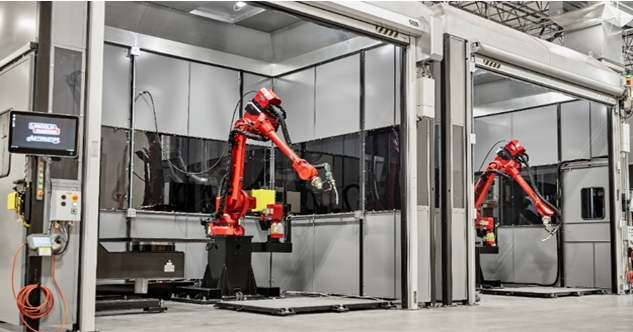
Steel AM, commonly referred to as 3D printing with steel weldment, introduces a new dimension to structural design. Unlike traditional fabrication methods, steel AM enables engineers to create complex geometries that are difficult—or impossible—to achieve with standard rolled steel shapes. This capability is particularly valuable for custom components and connections where conventional fabrication techniques fall short.
The AISC bridge demonstrates how steel AM can complement traditional structural sections, merging advanced manufacturing with established engineering practices. By leveraging steel AM, designers can integrate aesthetic and functional requirements into single components, reducing complexity and improving efficiency.
Designing the Bridge
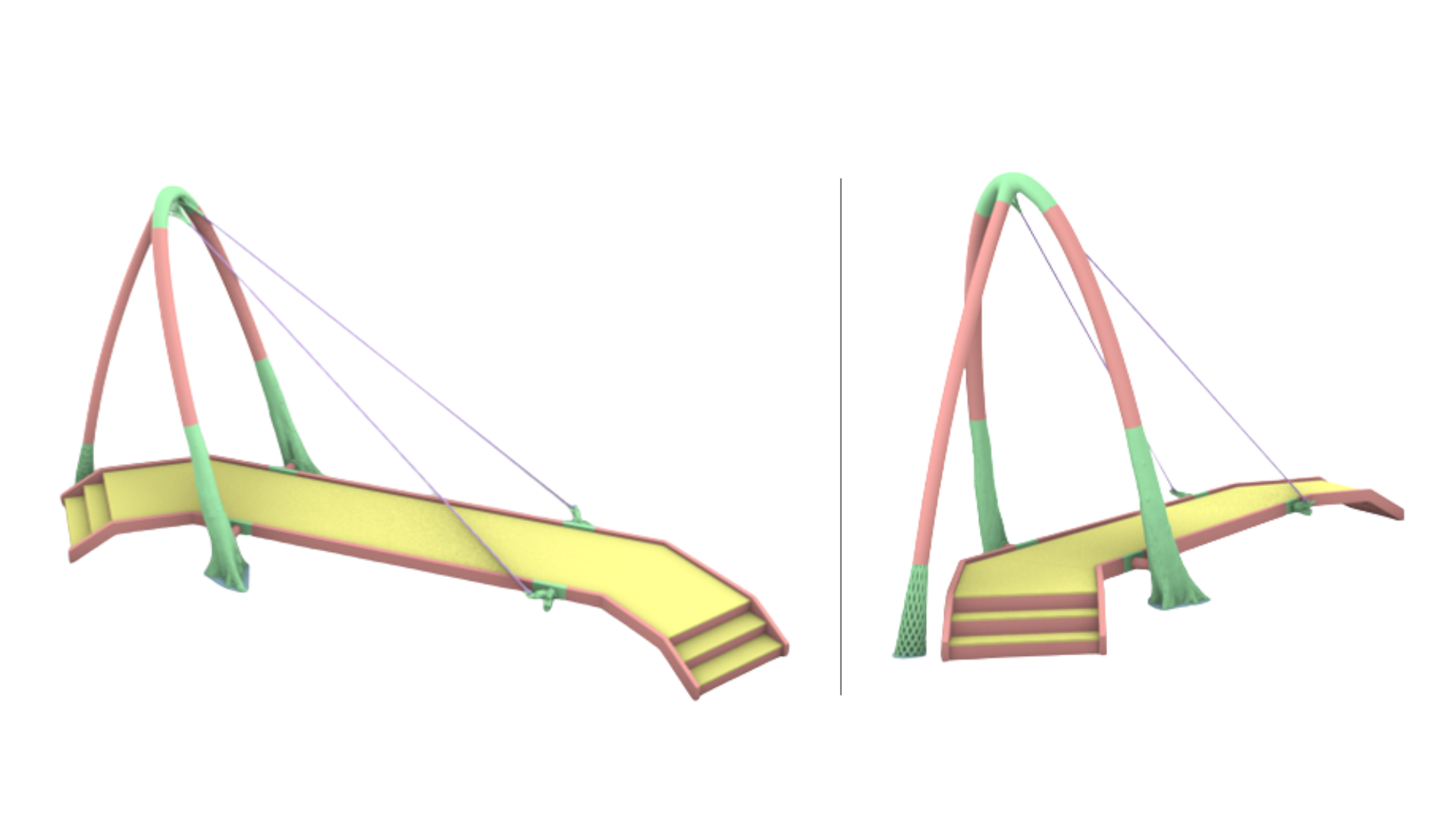
Magnusson Klemencic Associates (MKA) led the architectural vision for the project: a modular, 50-foot (15-meter) long, three-span pedestrian bridge inspired by organic forms found in nature. The design imagined a hypothetical river within a wooded site, with canted arches symbolizing leaning trees, and tendril-like tension rods supporting a curved bridge deck. Arch backstays, shaped like wetland reeds, were intended to blend seamlessly into the hypothetical forest floor.
To achieve this natural aesthetic, actual tree trunks were scanned and converted into digital models. These files informed the design of structural components, including bent hollow structural sections (HSS) and 3D printed elements. The result was a striking 17-foot (5-meter) high, 10-foot (3-meter) wide arch with a radius tighter than advanced HSS bending techniques can accomplish. By 3D printing the arch’s top components and welding them to curved HSS, the team realized a form that would have been impractical using traditional fabrication methods.
Engineering the Components
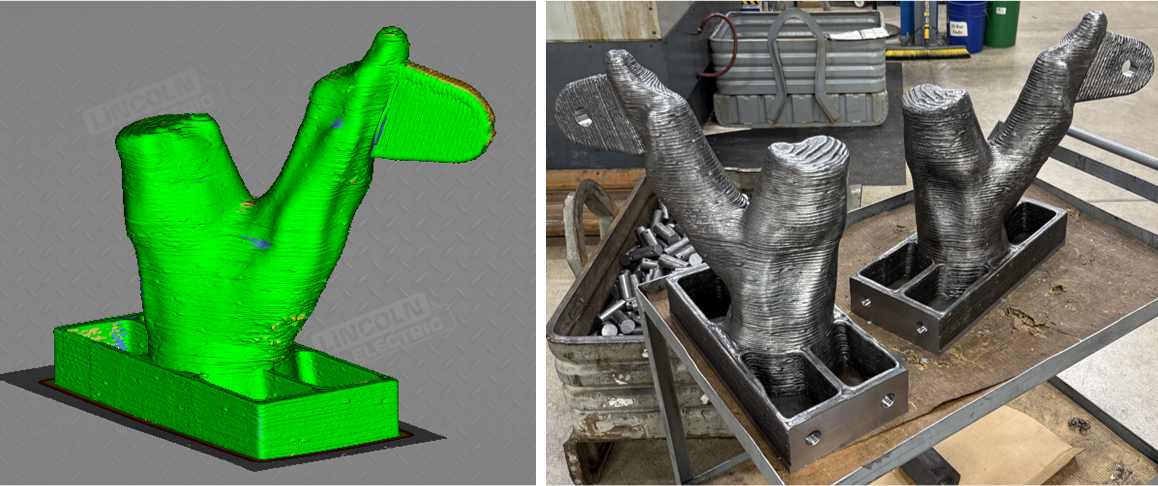
CAST CONNEX, an AISC Associate Member, played a critical role in transforming conceptual designs into manufacturable steel AM parts. CAST CONNEX responsibilities spanned detailed engineering, finite element analysis (FEA), and development of shop drawings for production. Working closely with MKA, Lincoln Electric Additive Solutions (AM manufacturer), SteelFab (fabricator), and machine shops, CAST CONNEX addressed a range of design constraints, including:
- Structural Performance: Ensuring stiffness and strength through code-based calculations aligned with the AISC Specification (ANSI/AISC 360-22).
- Architectural Intent: Preserving the organic aesthetic while meeting structural engineering requirements.
- Manufacturing Feasibility: Accounting for minimum printable thickness, overhang limitations, and heat-induced warping during welding.
- Fabrication and Erection: Designing components for shop welding and field bolting to streamline assembly.
Innovative Connection Features
The project highlighted steel AM’s ability to integrate multiple innovations into the 3D printed components. Key innovations included:
- Build Plate Integration: 3D printing components directly onto build plates that became part of the final geometry, followed by CNC machining to correct warping and ensure dimensional accuracy.
- Internal Stiffeners: Adding internal features to improve connection stiffness without excessive material use, as revealed by FEA.
- Hybrid Connections: Designing welded joints with extra stock for machining and smooth finishes, alongside bolted connections featuring printable pockets and teardrop-shaped hand holes for bolt access.
- Sequential Manufacturing: Producing detailed documentation for both as-printed and as-machined stages, including tolerances and fixture balancing to accommodate dimensional variations.
.png)
These solutions exemplify how steel AM can resolve structural, architectural, and fabrication challenges simultaneously—something traditional fabrication methods struggle to achieve.
Collaboration and Impact
The success of the AISC bridge reflects a collaborative effort among industry leaders: CAST CONNEX engineered the steel AM components, Lincoln Electric provided additive manufacturing expertise, SteelFab handled fabrication, and Georgia Tech contributed research insights. Together, they demonstrated that AM is not just a novelty but a practical tool for advancing structural steel design.
While the AISC bridge was initially an exhibit, its role in ongoing load testing underscores its significance as a research platform. By pushing the boundaries of what is possible with structural steel, this project paves the way for future applications of steel AM in bridges, buildings, and other infrastructure.
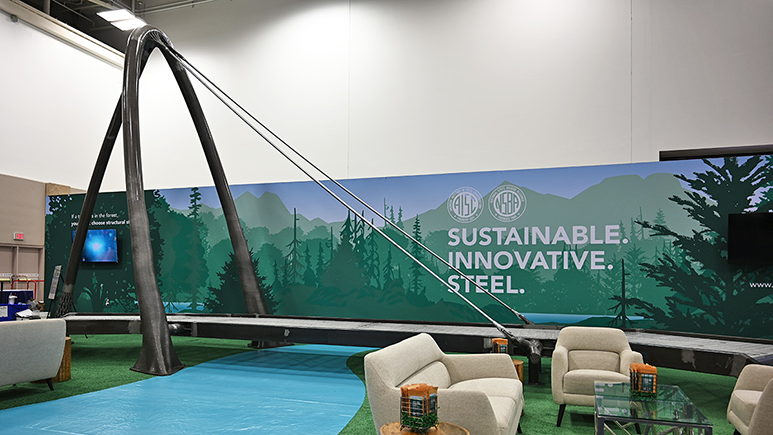
The Future of Steel AM
As steel AM technologies mature, their integration into structural engineering will likely accelerate. Projects like the AISC bridge prove that steel AM can deliver both aesthetic and functional benefits, enabling designs that were once considered unattainable. For engineers, architects, and fabricators, steel AM represents a new frontier—one where creativity and performance converge.
In November 2025, Modern Steel Construction Magazine published an article titled 'Hot off the Press' co-authored by Justin Binder, Engineering Manager at CAST CONNEX, and four key members of the AISC bridge team.
You can Download the Full Modern Steel Construction Article Here ↗


.png)


